

After surgery to remove a brain tumor located in my left frontal lobe, I awoke in the intensive care unit unable to speak, a condition I had little experience with personally but had learned lots about in graduate school.
I could hear nurses laughing and carrying on but I wasn’t able to say anything to quiet them. In my mind I was assessing my current situation: The nurses are being really loud, I thought the ICU was supposed to be peaceful.” And, more pointedly, “Gosh, I’m starving and really uncomfortable.”
Each time the nurse came in, she unknowingly left me with unmet needs. Eventually only those closest to me could figure out what I needed by my use of gestures. When my brother came to visit me he was carrying crackers, for example; I grabbed the box out of his hand and started eating like I had not eaten in a long time. He immediately told the nurse I was starving and she brought me lunch.
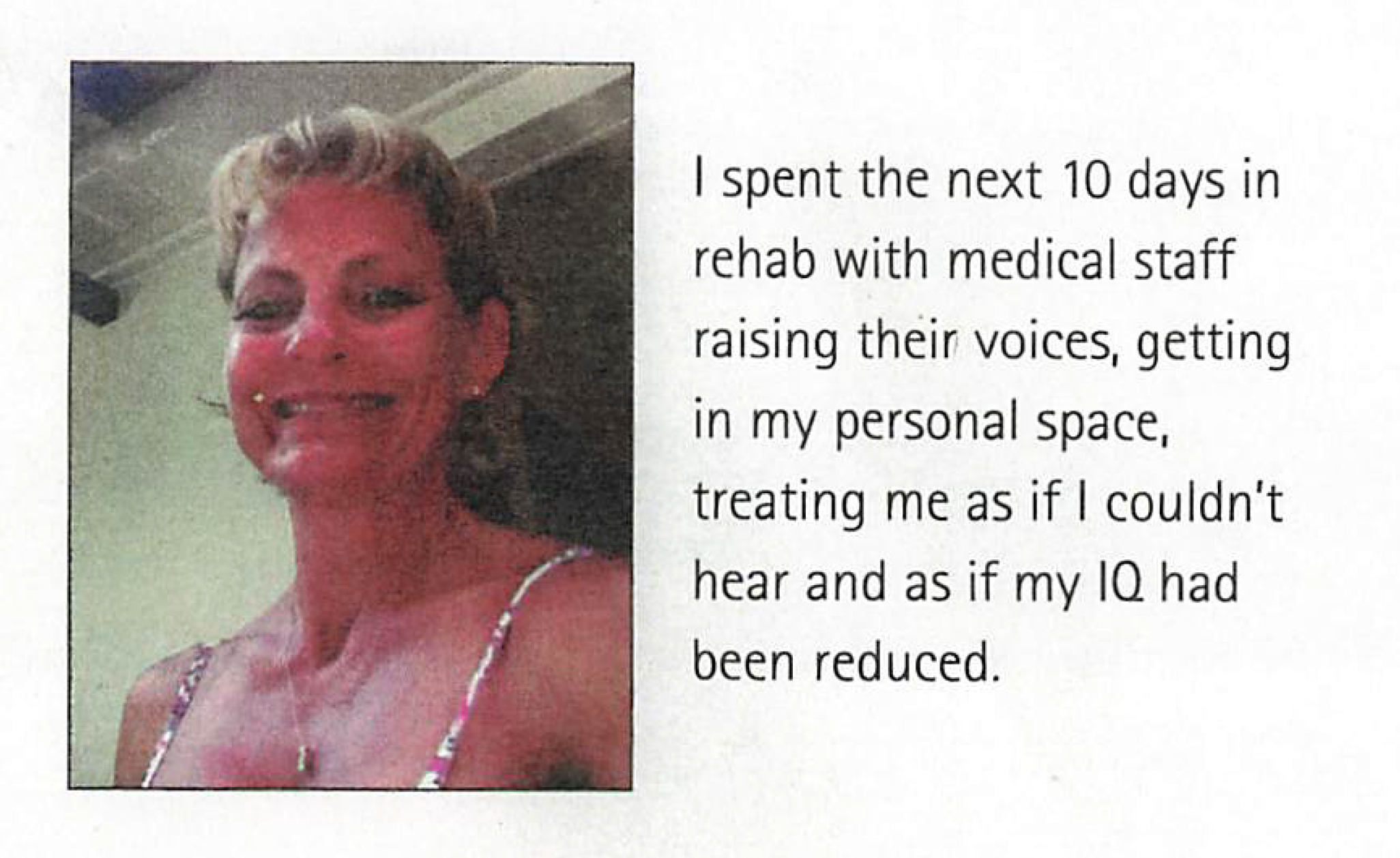
I spent the next 10 days in rehab with medical staff raising their voices, getting in my personal space, treating me as if I couldn’t hear and as if my IO had been reduced. Eventually I was given a pen and paper so I could write my requests.
I spent the next 10 days in rehab with medical staff raising their voices, getting in my personal space, treating me as if I couldn’t hear and as if my IQ had been reduced.
As part of my treatment I went to the rehab cafeteria to eat, and my husband came with me. I needed some ketchup; I told my husband this through gestures by pointing at my fries. He guessed, “You need ketchup?” I nodded my head, “Yes.” He called the waitress over and told me to tell her what I needed. I couldn’t even tell him—how did he expect me to tell her?
I knew my speech-language pathologist, Mike, had to educate my husband, because I was nervous about going home with him if he didn’t understand. After their chat, my husband was great and I felt safe.
But still I felt very lonely; the only people I felt comfortable with were my husband and my new best friend, Mike. He knew what I was going through; he was sympathetic, listened, and gave me the time I needed. His acceptance and respect motivated me.
His ability to make me believe he knew exactly how hard it was to be unable to express my basic wants and needs was key to my recovery.
It was a long and emotional journey. I returned to work with a better understanding and appreciation for the power of words. I have more patience for my students when they have word-finding issues. I understand the importance of educating family more than ever, as I’ve lived without words and have learned the true power of the spoken word.
Angel Carson, MS, CCC-SLP, is a clinician with the Orange County (Florida Public Schools.
Contact her at ank95@aol.com.
– Originally Published in ASHA Leader